Solar for Factories: Cut Energy Costs & Get a 4-5 Year Payback | The Perfect Match

Honestly, if you own a factory or a cold storage facility, you know that heart-pounding feeling you get every month when the electricity bill arrives. It’s not from happiness, but because the numbers are truly staggering. On some hot months, the electricity cost can easily exceed a hundred thousand baht.
When I say that solar cells are most suitable forFactories, Cold storage, andคลังสินค้าควบคุมอุณหภูมิ and temperature-controlled warehouses, it’s not because I sell them (haha). It's because these businesses are a genuine "Perfect Match" for a solar cell system. Let's explore why.
Table of Contents
ทำไมการติดตั้งโซลาร์เซลล์โรงงาน คือ Perfect Match ที่สุด
1. The Perfect Pair: Flawless Timing of Power Consumption and Generation
Think about it: when does your cold storage factory use the most electricity? That's right! During the daytime when the sun is hottest. The stronger the sun, the harder the compressors have to work.
And what about solar cells? When do they produce the most power? During the peak sun hours as well!
Look at the electricity usage pattern of a cold storage factory:
- Morning (6-9 AM): Moderate usage (starting to warm up)
- Late Morning (9 AM - 12 PM): Usage increases (sun gets stronger)
- Afternoon (12 PM - 4 PM): Peak usage (very hot!)
- Evening (4 PM - 6 PM): Usage decreases (sun weakens)
Now, look at the power generation pattern of solar cells:
- Morning (6-9 AM): Produces a small amount of power
- Late Morning (9 AM - 12 PM): Production increases significantly
- Afternoon (12 PM - 4 PM): Peak production
- Evening (4 PM - 6 PM): Production decreases
See? They're a perfect match! When you need the most power, the solar cells are producing the most power. You don't have to buy expensive electricity from the grid.
2. High Consumption = High Savings (Simple Economic Math)
Consider this: a typical cold storage factory consumes 50,000-200,000 units of electricity per month. If the rate is 4-5 baht per unit, you're paying 200,000 - 1,000,000 baht per month for electricity!
Let's do the math for a medium-sized cold storage factory:
- Electricity Usage: 100,000 units/month (which is standard for this business)
- Average Electricity Cost: 4.5 baht/unit
- Monthly Electricity Bill: 450,000 baht (5.4 million baht a year!)
- If you install a 500 kW solar system (installation cost of around 15 million baht)
- Savings: 70% = 315,000 baht/month
- Payback Period: 4-5 years (after that, it's almost free profit!) (หลังจากนั้นก็เป็นกำไรเกือบฟรีๆ!)
- Total Return over 20 years: 60-75 million baht (not including future electricity price hikes) (ไม่รวมค่าไฟที่เพิ่มขึ้นในอนาคต)
Are you still hesitating? If you have 15 million baht to spare, investing in solar cells is better than putting it in a bank. A bank offers 2-3% annual interest, but this provides a return of almost 20% per year!
3. Double Benefit: Solar Panels are Like a Free Extra Layer of Roof Cooling
Installing solar panels on your roof doesn't just give you electricity; it also acts as an excellent layer of thermal insulation, directly shielding your building from the sun. The results are:
- Temperature under the roof drops by 3-5 degrees Celsius: This reduces the amount of heat transferring into the building.
- Compressors work less: When the interior isn't as hot, the cooling system doesn't have to work as hard.
- Save an additional 5-10% on electricity: This is a free bonus on top of the power you generate.
- Extend equipment lifespan: When machinery works less, it naturally deteriorates more slowly.
Which Solar System is Right for Your Factory?
1. On-Grid System
This is the system we recommend most! Why? Because it's the simplest and most cost-effective.
Pros:
- Simple, uncomplicated installation.
- Excess power produced can be sold back to the utility.
- Lowest investment cost.
- No need to worry about batteries.
Cons:
- When the grid goes down, the solar system also shuts down (for safety reasons).
2. Off-Grid System (Solar + Battery)
For those who want 200% confidence.
Pros:
- Can still operate during a power outage (crucial for cold storage!).
- Store energy to use during peak price periods.
- No worries about power irregularities.
Cons:
- Higher cost (due to the battery purchase).
- Batteries have a limited lifespan and typically need replacement every 8-10 years.
3. Hybrid System
The ultimate in perfection, but the price is "perfectly" high as well.
Who Should Choose What?
- If power outages are frequent in your area → Choose a system with a battery.
- If the power supply is stable and you want maximum savings → Choose a Grid-Tied system.
- If you have ample funds and want everything → Choose a Hybrid system.
Checklist Before You Decide (Don't Jump into the Investment Just Yet!)
First, Check the Technical Aspects
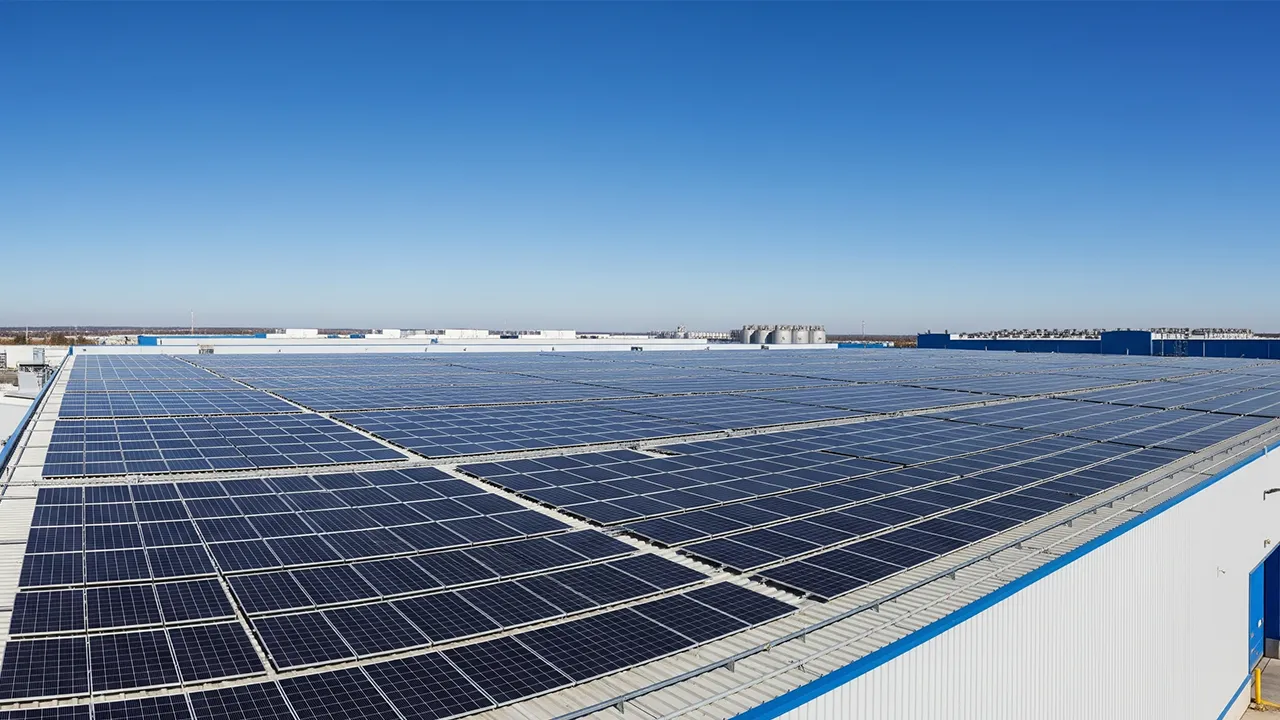
Can your roof handle it?
- You need at least 3,000-5,000 square meters of unobstructed roof space.
- The structure must be strong enough to support an additional 15-20 kg per square meter.
- A south-facing roof is best (but east-west is also viable).
What is your current electricity situation?
- Review your electricity bills for the past 12 months.
- Which periods have the highest usage? (It should be during the day).
- Do you have plans for business expansion?
Next, Check the Financials
Numbers you should know:
- Initial investment is about 25-30 baht per watt (larger systems are cheaper per watt).
- The average payback period is 4-6 years (if you use a lot of electricity, the payback is faster).
- The lifespan is 20-25 years (panels come with a performance warranty).
Advice from someone who's been there:
- Don't choose the cheapest solar panels; they will cause problems in the future.
- Choose a company with real experience in factory installations, not just residential ones.
- Ask to see their actual portfolio, not just a price quote.
Installation System
Opt for an installation with Micro Inverters. Installing a solar cell system with Micro Inverters has several distinct advantages over String Inverters, especially in terms of efficiency, safety, and design flexibility, despite a higher initial cost.
Comparison Table: Micro Inverter vs. String Inverter
Topic | ✅ Micro Inverter | ❌ String Inverter |
Efficiency in Shade | Excellent! Each panel operates independently; others are unaffected. | Decreased across the system. The efficiency of all panels is dragged down to the level of the weakest one. |
Safety | Very high. Converts to low-voltage AC power right at the panel, reducing fire risk. | Lower. High-voltage DC cables (600-1000V) run across the roof. |
System Monitoring | Detailed. Monitor the performance of individual panels via an app. | General. Can only see the combined performance of the entire string. |
Design Flexibility | Very high. Supports roofs facing multiple directions; easy to add more panels in the future | Limited. Must be designed in groups (strings); difficult to add more panels. ต้องออกแบบเป็นกลุ่ม (String) เพิ่มแผงได้ยาก |
Lifespan/Warranty | Long (12-25 year warranty). | Shorter (5-12 year warranty). |
Initial Cost | Higher. | Lower. |
Getting Started Steps
1. Feasibility Study
- Analyze electricity consumption from the past 12 months.
- Inspect the condition of the roof structure.
- Assess the potential for electricity generation from the available area.
2. System Design
- Calculate the appropriate system size.
- Select the type of equipment best suited for your usage.
- Estimate the cost and return on investment.
3. Installation and Testing
- Installation by an expert team.
- System and connection testing.
- Handover with a user manual.
Case Studies
Company A (Frozen Warehouse):
- Installed an 800 kW solar system.
- Saved 65% on electricity costs (500,000 baht/month).
- Payback period of 4.2 years.
- Cumulative 15-year return = 90 million baht.
Company B (Ice Cream Factory):
- Installed a 1,200 kW solar system.
- Saved 70% on electricity costs (800,000 baht/month).
- Payback period of 3.8 years.
- Reduced carbon emissions by 1,500 tons of CO2/year.
You can also try using an Online Solar Calculator first.
Conclusion: Why You Shouldn't Wait
For businesses like factories, cold storage, or temperature-controlled warehouses, installing solar cells isn't just about reducing energy costs. It is an investment that:
- Offers a clear return from significant savings on electricity bills.
- Reduces risk from future electricity price hikes.
- Increases business value by being an environmentally conscious organization (ESG)
- Allows you to receive government benefits at the right time.
Cold storage businesses looking to transform massive electricity costs into a worthwhile investment can start exploring their potential with PUMA SUNERGY , which has experience in designing systems for factories requiring high energy stability.
Delaying the decision means losing the opportunity to save hundreds of thousands of baht per month, while electricity rates and installation costs trend upwards every year. Investing in solar cells today is the smartest decision for your business.
Share the Post: